Is SpinShark Safe in the UK? UKGC Licence Check, Trust and Player Context
 Available in GB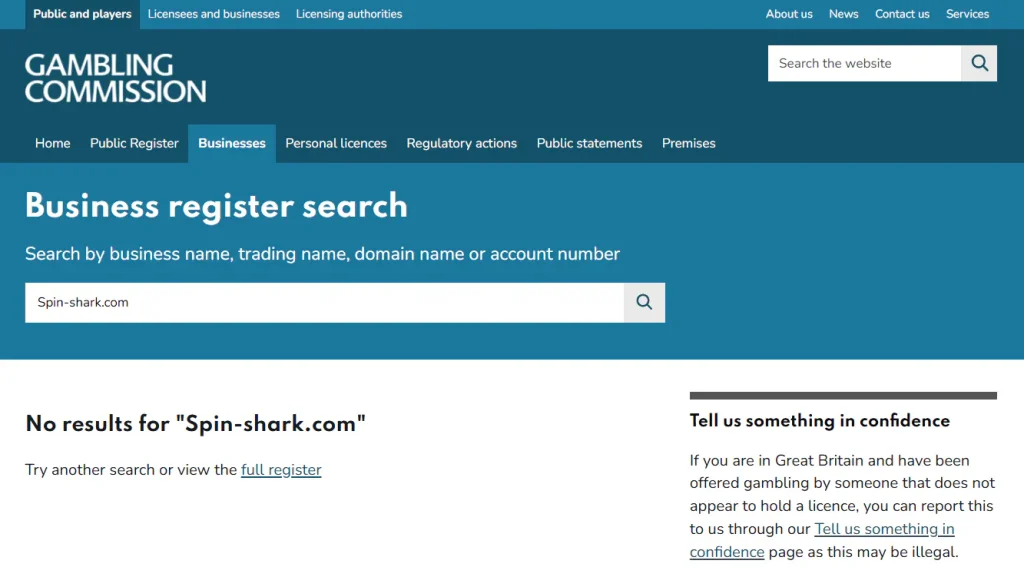
Regulator-first trust check – 12 September 2026
The 12 September 2026 UK Gambling Commission business-register lookup left the SpinShark licence-match set empty. For consumers in Great Britain, an online casino serving customers requires the relevant Gambling Commission remote operating licence, regardless of where the business itself is based. That makes the missing register match a material trust issue for a Great Britain player. Northern Ireland has a separate gambling-law framework, so the Great Britain register result defines SpinShark’s regulatory position only for the Great Britain scope. For Great Britain, that register outcome leaves UKGC authorisation and Great Britain licence-condition coverage outside the regulatory position verified for SpinShark.
Table of Contents
- The UKGC register position for SpinShark
- Why the register result matters in Great Britain
- Great Britain and Northern Ireland have separate regulatory scopes
- What current Great Britain rules look like for licensed operators
- SpinShark's 40x wagering requirement versus the UKGC 10x cap
- Payment branding serves a different purpose from licensing
- GAMSTOP, stake limits and vulnerability checks depend on the licensed framework
- SpinShark has support and security tools, but they serve a different purpose from a licence record
- Withdrawal terms are product information, not regulatory proof
- A regulator-first checklist before deciding whether to play
- What the missing UKGC licence means for a SpinShark decision
The UKGC register position for SpinShark
The Gambling Commission’s public business register lists businesses licensed for Great Britain. Its 12 September 2026 query produced an empty licence-record set for SpinShark.
The current public register gives an empty result set for each of three queries: SpinShark, Spin Shark and the spin-shark.com domain. The register result leaves the identity of any alternative regulator, any offshore licence and any disputed operator identity unresolved.
The Gambling Commission business register can be used to repeat the check rather than inferring licensing from payment options, KYC processes or support tools.
For decision-making, that direct regulator check deserves more weight than indirect signs of professionalism. A polished presentation, familiar payment options and detailed terms describe the product, while Great Britain authorisation is determined by the regulator register.
Why the register result matters in Great Britain
The Gambling Commission states that, regardless of where a business is based, it needs the relevant licence if it provides remote gambling facilities to consumers in Great Britain. For an online casino contracting directly with customers, that is the remote casino operating licence.
This is the important regulatory baseline for Great Britain. A casino can support GBP, accept account registrations and offer familiar payment brands while those product features remain separate from UKGC authorisation. Licensing is a separate fact that comes from the regulator record.
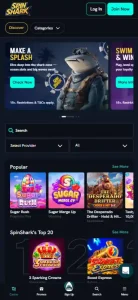
Product features and the Great Britain licensing position remain separate: SpinShark offers games, bonuses, payments and account functions, while the corresponding Gambling Commission lookup leaves the SpinShark UKGC licence list empty.
For a trust decision, this separation matters more than a simple score. Product features show what SpinShark offers and how its own rules are written. The regulator record shows which external licensing framework applies to a listed business or domain. A strong feature list is insufficient to answer the second question, so the register result should be considered independently from convenience features.
Great Britain and Northern Ireland have separate regulatory scopes
UK-wide wording can become misleading because the Gambling Act 2005 framework administered by the Gambling Commission is a Great Britain regime. Northern Ireland has a separate gambling framework under the Betting, Gaming, Lotteries and Amusements (Northern Ireland) Order 1985, as amended, and its wider online-gambling reform has followed a different path.
The Great Britain UKGC lookup produces an empty licence-record set for SpinShark. Northern Ireland has a separate gambling-law framework, so Great Britain consumer rules apply there under a separate framework.
What current Great Britain rules look like for licensed operators
A useful way to judge the significance of licensing is to look at rules that apply to Gambling Commission licensees. These rules describe the regulated Great Britain market. They provide regulatory context for comparison rather than allegations of a UKGC licence-condition breach by SpinShark; the register query produced an empty SpinShark licence-record list.
| Great Britain rule for relevant licensees | Current requirement | Why it matters when assessing SpinShark |
|---|---|---|
| Bonus wagering | Maximum 10x bonus funds from 19 January 2026 | SpinShark’s current general bonus terms state 40x unless a promotion says otherwise. |
| Credit-card gambling | Credit cards are prohibited, including credit-card-funded e-wallet routes | Generic Visa/Mastercard wording is insufficient proof of permitted UK credit-card use. |
| Online slots stakes | £5 per game cycle for age 25+ and £2 for ages 18-24 | These are conditions on Great Britain remote casino licences. |
| Financial vulnerability checks | Relevant licensees use a £150 net-deposit threshold over a rolling 30 days | This is part of the licensed-market customer-interaction framework. |
| GAMSTOP | Covers websites and apps run by businesses licensed in Great Britain | The UKGC register currently provides no supporting licence entry for SpinShark GAMSTOP coverage. |
SpinShark’s 40x wagering requirement versus the UKGC 10x cap
SpinShark’s current bonus terms state that, unless a promotion specifies otherwise, bonuses and free-spin winnings must be wagered 40x. The current UKGC Social Responsibility Code caps wagering requirements applied by licensees at a maximum of 10 times bonus funds and also prevents a single incentive from mixing more than one gambling product type. Those changes took effect on 19 January 2026.
SpinShark’s general bonus rule uses 40x wagering, while UKGC licensees are capped at 10x bonus funds. The 10x rule is a UKGC licence condition, and the UKGC record set produced by the SpinShark lookup is empty, placing that condition within the licensed-market benchmark rather than the conditions evidenced for SpinShark.
The current bonus terms should be assessed together with their wagering conditions. The trust takeaway is simply that a Great Britain licensed operator is now constrained by a 10x cap, while SpinShark’s own published general terms show 40x.
Payment branding serves a different purpose from licensing
SpinShark’s terms mention Visa and Mastercard alongside alternative payment options, and GBP is supported for deposits and withdrawals. In Great Britain, however, gambling businesses are prohibited from accepting credit-card payments for gambling, including where an e-wallet was funded by a credit card.
SpinShark’s card-brand support can include debit-card use or availability in other jurisdictions, while Great Britain licensees are prohibited from accepting credit-card gambling payments. Card-brand support therefore provides insufficient basis for establishing UK credit-card availability. The payment methods show the brand’s listed payment categories alongside the separate Great Britain credit-card rule.
GAMSTOP, stake limits and vulnerability checks depend on the licensed framework
GAMSTOP is a national online self-exclusion route for gambling websites and apps run by businesses licensed in Great Britain. The public-register query leaves the SpinShark UKGC licence list empty, leaving GAMSTOP participation outside the facts currently confirmed for SpinShark.
Current Great Britain online-slot stake limits are also licence conditions: £5 per game cycle for adults aged 25 or over and £2 for adults aged 18 to 24. Separately, relevant remote licensees use light-touch financial vulnerability checks when deposits minus withdrawals exceed £150 over a rolling 30-day period. The Gambling Commission describes these as financial vulnerability checks, not a universal manual affordability assessment.
These rules matter because a licence entry provides a concrete regulatory framework. The SpinShark UKGC licence lookup produces an empty result set, so those Great Britain licence protections, controls and dispute routes sit outside the regulatory framework evidenced for a SpinShark account.
SpinShark has support and security tools, but they serve a different purpose from a licence record
SpinShark does show several trust-relevant account features. Live chat is listed as available 24/7. Its responsible-gaming information says players can request self-exclusion through Support via Live Chat. Its privacy policy states that two-factor authentication can be enabled for added account protection.
These are useful operational features, but they answer different questions from licensing. A self-exclusion request handled by one casino has a narrower scope than GAMSTOP’s multi-operator coverage. Two-factor authentication protects login access; it demonstrates account security rather than regulatory authorisation. Likewise, a support channel can help with an account issue while UKGC complaint and ADR rights remain tied to the applicable regulatory framework.
KYC is another separate control. SpinShark can request identity documents before payouts, and SpinShark KYC can involve ID, payment and address documents plus account-side uploads. Verification may be important for account security and withdrawals, but it is still not a licence certificate.
Withdrawal terms are product information, not regulatory proof
SpinShark publishes concrete withdrawal conditions, including a £20 minimum GBP withdrawal and general GBP limits. Those terms set practical payout boundaries, and SpinShark withdrawals include the current minimum, general caps and bank-transfer timing.
Detailed cashier rules describe the operator’s product conditions, while the Gambling Commission register and licensing framework determine Great Britain authorisation. These are separate parts of the account and regulatory picture.
A regulator-first checklist before deciding whether to play
Facts to weigh
- The 12 September 2026 register query left the SpinShark UKGC licence-record set empty.
- A remote casino serving Great Britain consumers requires the relevant UKGC licence.
- SpinShark publishes 40x general bonus wagering unless a promotion states otherwise.
- SpinShark offers 24/7 live chat, self-exclusion through support and optional 2FA.
- Identity verification can apply before withdrawals.
Regulatory points outside the current SpinShark evidence
- A matching SpinShark entry in the Gambling Commission business register.
- UKGC consumer protections or ADR coverage for SpinShark.
- GAMSTOP coverage for SpinShark.
- A specific offshore licence or settled operator identity.
- One regulatory status that applies identically across every UK jurisdiction.
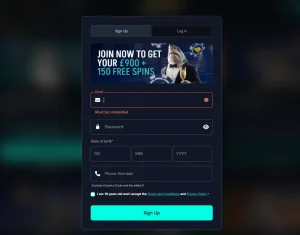
Account registration is a product-side process and leaves the separate Great Britain licensing question open. A successful sign-up confirms an available account flow; UKGC authorisation depends on a separate register record.
What the missing UKGC licence means for a SpinShark decision
In Great Britain, the decisive trust fact is that the 12 September 2026 Gambling Commission business-register lookup produced an empty SpinShark match set, while remote casinos serving Great Britain consumers require the relevant UKGC licence. Accordingly, UKGC authorisation, GAMSTOP participation, licensed-market consumer protections and Great Britain licence-condition coverage remain outside the regulatory position verified for SpinShark. SpinShark does publish account security, self-exclusion, KYC, payment and bonus terms, but those product features serve a different purpose from the regulator record. The practical decision is therefore to judge SpinShark with the missing UKGC match clearly separated from its separate product features, while keeping GBP support and a functioning account flow separate from the licensing question.